

Violation
Description
Real Horrors
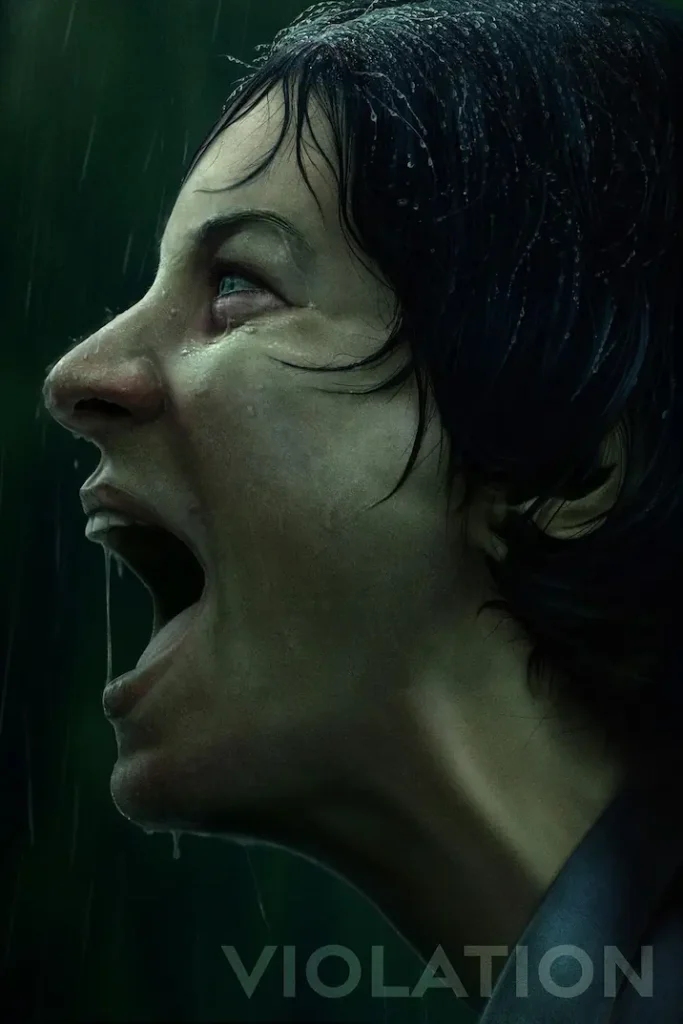
Violation is a bleak psychological horror film that presses down on your psyche and leaves an unpleasant aftertaste. But maybe it’s just me being sensitive — I might even cry. I watched it back in 2020 and I still remember the impression it made on me.
A couple comes to visit their friends at a country house. And almost immediately, things get heavy. No, there are no supernatural events in the film, no strangers show up at the house, no maniacs knock on the door, and no zombies surround it from all sides. All the horror happens exclusively between people who are friends and have known each other for years.
Actually, this is where information about Violation was supposed to go, but its plot inspired me to write a mini-essay on why I don’t like real horror. I don’t like the horror that surrounds us. You might need a moment to process what I just said — after all, you’re in a place where horror is literally the foundation of all the content on Vegan Vampire. Don’t worry, I’ll explain everything now.
When I watch some psychological drama or hard-core arthouse like Violation, Enter the Void or Lilya 4-ever, I realize that all this horror could be happening right here, right now.
We can ignore the evil that surrounds us, or pretend we don’t notice it. And that’s understandable — it’s simply easier to live that way. But just because we don’t notice the evil, or don’t want to notice it, doesn’t mean it doesn’t exist.
Injustice, inequality, hunger, poverty and wars. Those are the real horrors. They surround us everywhere.
But in horror films with fictional plots, I know it’s all make-believe and nobody actually got hurt — monsters don’t exist. Although that depends on how you look at it: there are plenty of films showing that the real monsters are people. You don’t even need to prove it — just look away from the screen and look at the events happening around us.
Horror films are a pleasant pastime that doesn’t weigh you down or force you to think about the horrors of the real world.
Actually, it’s the opposite — horror films are my way of escaping the horrors of the real world. Just like making art is.
My grandmother is a child of the war, and she’s quite elderly now. She often scolded me for watching some crap whenever she saw monsters on the screen. But at the same time, she herself endlessly, from morning till night, watches Soviet and Russian war films and TV shows that regularly feature people’s everyday problems. I won’t go into the details of why they show that, because it depends on the time, the situation and the country you live in.
My argument with my grandmother about what real horror is ended in a draw: we each kept our own opinion.
I hope I managed to explain why I prefer made-up plots with fictional characters.
Although it would be cool if Batman existed in the real world.
Twenty years ago, Roland Emmerich’s films looked like unimaginable science fiction. And now we feel like we’re one step away from that reality.
Yes, I’ve drifted into global problems again. Now I have to explain that films like Don’t Look Up make me think yet again, and I recommend them to everyone I can reach, so they’ll think too. But films like that don’t drive me into depression and don’t terrify me.
What plunges me into horror are stories where children are forced into prostitution to feed themselves and their families. Where a single mother tries to survive in a world that seems not to notice her. Where religious fanatics force people to live like cattle, imposing all kinds of prohibitions and preaching medieval nonsense.
Someone always has to pay for power and wealth. And it’s the most vulnerable who pay for it.
Those are the real horrors — the actual ones. None of this should exist in the twenty-first century.
I’m not saying that heavy films, often based on real events, shouldn’t be made — on the contrary, they should. People need to know and see what’s happening. These films should influence something and someone. They should change something.
In the end, we will remember not the words of our enemies, but the silence of our friends.
— Martin Luther King
Everything required of me as a citizen of this planet, I do — and then some. The rest is beyond my power to influence. At the same time, I know plenty of people who do absolutely nothing to improve the situation even at the level of their own municipality. And each of them has their own reasons.
I’m absolutely sure: if everyone did even half of what I do, we would live in a completely different world. And I don’t do all that much, really.
Sometimes it’s enough just not to be indifferent.
Anyone can be a hero. Even an ordinary person, simply putting a jacket around a little boy’s shoulders so he understands that the world hasn’t ended (from the amazing film The Dark Knight Rises).
For evil to triumph, it is enough for good people to do nothing.
— Edmund Burke
Yes, fictional heroes like Batman and the Justice League wouldn’t hurt. Maybe at least they could put an end to the violation of our planet and its inhabitants. But there are no guarantees there either.
Power corrupts, and absolute power corrupts absolutely.
— Lord Acton
If you don’t get what I mean, watch Watchmen — Zack Snyder’s Ultimate Cut, or the adaptation of Alan Moore’s original graphic novel as a two-part animated film.
P.S.
If I had known in advance that there was nothing supernatural in Violation, I wouldn’t have watched it. But I don’t regret that it’s stuck in my memory: it’s just so uncomfortable, laying bare human nature and showing everything as it is.