


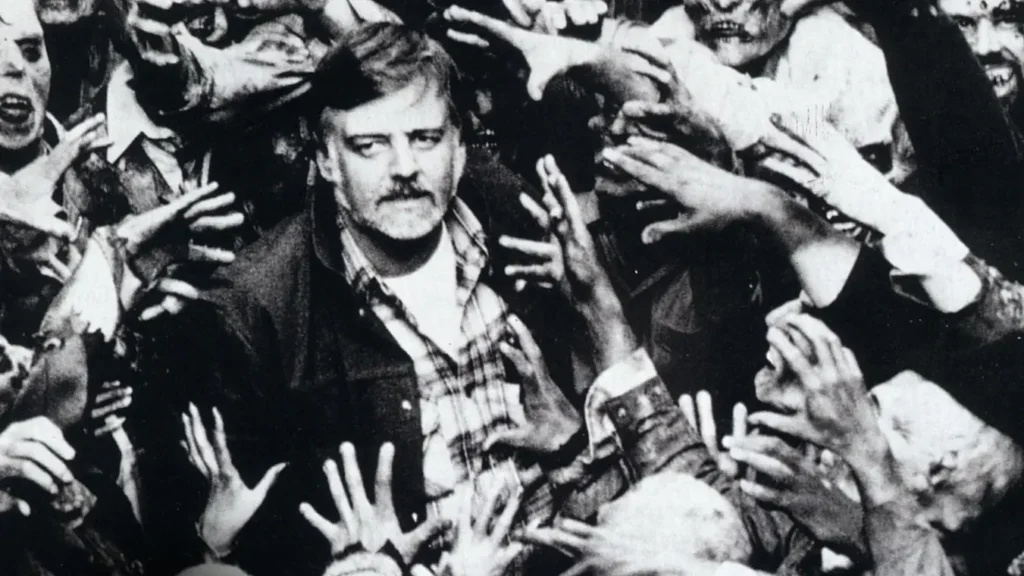
George Romero and His Zombies
Article + Film Collection
Most of us are familiar with George Romero and his zombies — the director who essentially created the zombie horror genre. Even if you’ve never seen one of his films, you’ve probably watched movies inspired by his universe or remakes of his cult classics. Although Romero didn’t only make films about the living dead, they’re what made him a legend.
Films featuring zombies were being made long before Romero’s first zombie film. But these were completely different creatures — their appearance didn’t lead to an apocalypse, they didn’t always bite, and they were more like isolated individuals. It was Romero’s zombies who began bringing the world to ruin, turning it into a reflection of human fears and social conflicts.
Four years before Night of the Living Dead, the film The Last Man on Earth (1964) starring Vincent Price was released — an adaptation of the book I Am Legend (the Will Smith film of the same name is also based on this work). In this gothic-styled film, half-zombie half-vampires — let’s call them “zompires” — attack the last man on earth in a post-apocalyptic world. This was very different from the realistic atmosphere of Night of the Living Dead and its social satire.
Thanks to his Dead trilogy, Romero is considered the creator of the modern image of slow zombies and the philosophy of zombie cinema. These films became a cultural phenomenon and a symbol of social problems. Romero turned zombies into a mirror of society, and each installment into a metaphor of its time. Although the trilogy actually turned into a tetralogy — the fourth film came out twenty years after the third. That is, already after Romero’s contributions to social zombie films were recognized.
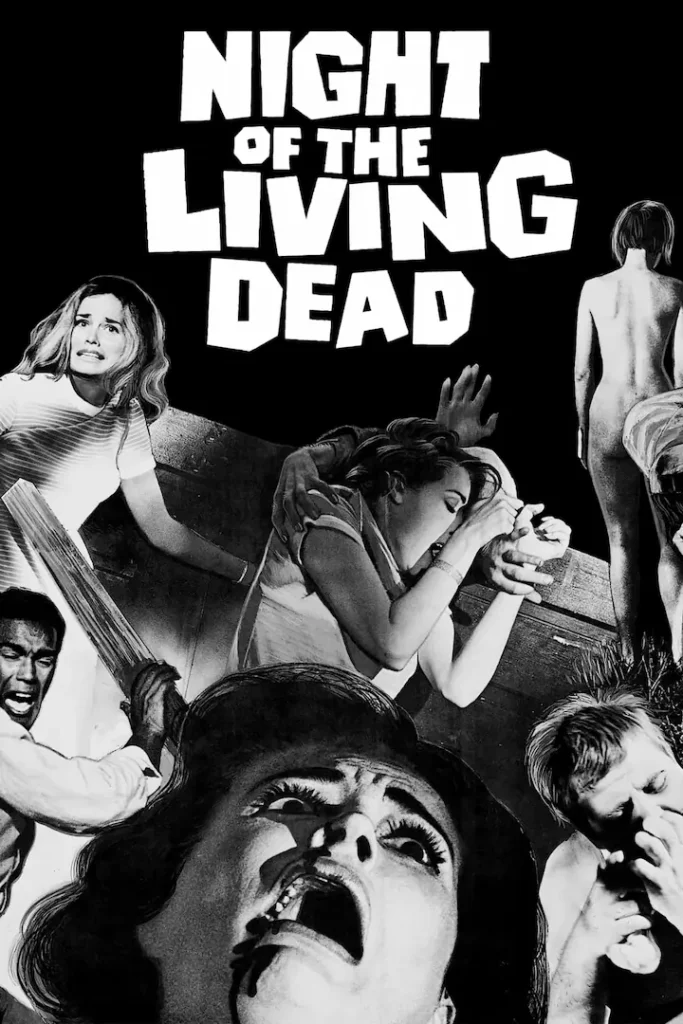
Initially, I wanted to collect films for those who can’t get enough of Romero’s slow zombies. But then I realized I could try to expand or supplement this universe with the help of other directors, selecting films and series that capture the atmosphere of the Canadian director’s work. And at least roughly arrange them in chronological order of events. It’s like a series and an anthology at the same time. Start with Night of the Living Dead and move in order.
Some films were made during the peak of zombie popularity, parallel to Romero’s works, while other, later films and series were inspired by his trilogy. Let’s imagine that around the same time, reanimated corpses began attacking the living all over the world. With the help of other directors, we can see the consequences of this phenomenon on other continents — where Romero never filmed. The dead attack the living in Europe, Japan, Africa, on remote tropical islands. Society collapses, tries to survive, and then starts building a new world in new conditions for itself.
The collection can be conditionally divided into two parts. The first is the “original” universe, completed by Romero in 2005 with Land of the Dead. The second is the reinterpretation — Diary of the Dead and Survival of the Dead. They reflect the development of the genre and Romero’s views on social changes in society.
Currently in development is Twilight of the Dead — based on George Romero’s last screenplay, which should be the final chord of his zombie epic. It’s a standalone story not directly connected to the previous installments. The director will be independent horror master Brad Anderson, and Milla Jovovich will play the lead role. Yes, I was surprised by her casting too. Will this turn off viewers, considering that Milla Jovovich’s image has long been associated exclusively with the Resident Evil franchise and the nightmare she sank deeper into with each subsequent film? To some extent, Jovovich became a hostage to this role.
In 1996, the first installment of the Resident Evil game series was released (in Japan it’s released under the name BIOHAZARD), and its developers at Capcom drew inspiration from George Romero’s films. This wasn’t the end of their chance acquaintance with Romero. In 1998, George Romero directed a live-action short for the second Resident Evil game. And he was supposed to direct the feature film, but at some point, his candidacy was rejected in favor of Anderson. The German studio Constantin Film, which bought the rights to the film, considered Romero’s draft screenplay too brutal and bloody. However, it was closer to the source material than Anderson’s screenplay, which was designed for a mass audience.
Considering that the first Resident Evil film was a box office success — which is the main goal for most studios — the producers made the right choice by hiring Anderson as director. And overall, it’s actually a good film if you don’t have inflated expectations; I like it. It also has a great soundtrack by Marco Beltrami and Marilyn Manson.
I like the second film too; it partially captures the atmosphere of the second and third games and their remakes. And even the third film was pretty good overall. But this realization came only after seeing what Paul Anderson showed in the subsequent films. And it’s hard to believe that Anderson once directed Mortal Kombat, Event Horizon, and the first Resident Evil. Although on the other hand, considering the trash that Disney and WB are churning out these days, the Resident Evil films from ten and fifteen years ago under Anderson’s direction aren’t that bad.
Of course, it would have been interesting to see Romero’s version of Resident Evil. You can find his screenplay on the internet. There’s also a documentary about how George Romero didn’t direct Resident Evil.
But let’s return to Twilight of the Dead. Specifically for the filming, Romero’s widow created a company that controls the production process and carefully preserves the director’s legacy. So you don’t have to worry about the quality of the upcoming film.
Earlier, Susan Romero, after her husband’s death, released The Amusement Park (1973), a social project commissioned by the Lutheran Society of Pennsylvania, dedicated to the problems of the elderly, which had long been considered lost. But the ratings agency banned it from screening due to excessive cruelty and violence on screen. In 2018, the film was found and, after restoration, finally saw the light of day in 2021.
Twilight of the Dead will complete more than half a century of Romero’s slow zombie history and summarize the director’s important contribution to the genre.
George Romero’s Zombiography:
Night of the Living Dead (1968)
Dawn of the Dead (1978)
Day of the Dead (1985)
Land of the Dead (2005)
Diary of the Dead (2007)
Survival of the Dead (2009)
Twilight of the Dead (in development)
A Collection of Films and Series That Could Expand George Romero’s Zombie Universe
I suggest watching these films not by release year, but by the possible chronology of events within the universe. This is my take on how these films could fill the non-existent gaps between Romero’s works and expand his zombie universe. Start with Night of the Living Dead and move in order — that way you’ll see how the zombie apocalypse would have unfolded around the world:
Night of the Living Dead (1968)
Day of the Dead 2: Contagium (2005)
Let Sleeping Corpses Lie (No profanar el sueño de los muertos, 1974)
Dawn of the Dead (1978)
Zombie (Zombie 2, 1979)
Day of the Dead (1985)
Night of the Living Dead (1990)
Junk: Shiryô-gari (2000)
Land of the Dead (2005)
Reboot, Reinterpretation, New Beginning:
Day of the Dead (series, 2021)
Diary of the Dead (2007)
It Stains the Sands Red (2016)
The Dead (2010)
The Dead 2: India (2013)
Survival of the Dead (2009)
The Battery (2012)
The Walking Dead: World Beyond (series, 2020–2021)
Twilight of the Dead (in development)
P.S. George’s daughter, Tina Romero, continued her father’s work and in 2025 released her debut film Queens of the Dead.
This film is not connected to George Romero’s films in any way.
Update:
The development of Twilight of the Dead was restarted in May 2026. The new directors are Doron and Yoav Paz, who directed the horrors Jeruzalem (2015) and The Golem (2018). Kate Beckinsale replaced Milla Jovovich.
I don’t know about you, but I’m glad about these changes. Brad Anderson isn’t what he used to be. And his recent films are very mediocre. The new directors can bring something fresh. And Milla Jovovich is certainly a good actress, but after so many years in the Resident Evil franchise, a new zombie film with her participation would probably be hard for me to perceive as a standalone film unrelated to the franchise, which by the end turned into almost trash.
I shared my thoughts on the Resident Evil reboot by Zach Cregger here.